
Introduction
This case reproduces the well-known Sjunnesson bluff-body flame holder experiment: a triangular cross-section bluff body mounted in a rectangular duct, used extensively in the CFD community as a benchmark for turbulence and combustion model validation. The flow separates from the bluff body and forms a pair of shear layers that roll up into a periodic vortex-shedding wake, which then relaxes towards the downstream channel flow.
The result shown here is the isothermal (non-reacting) baseline case.
Results
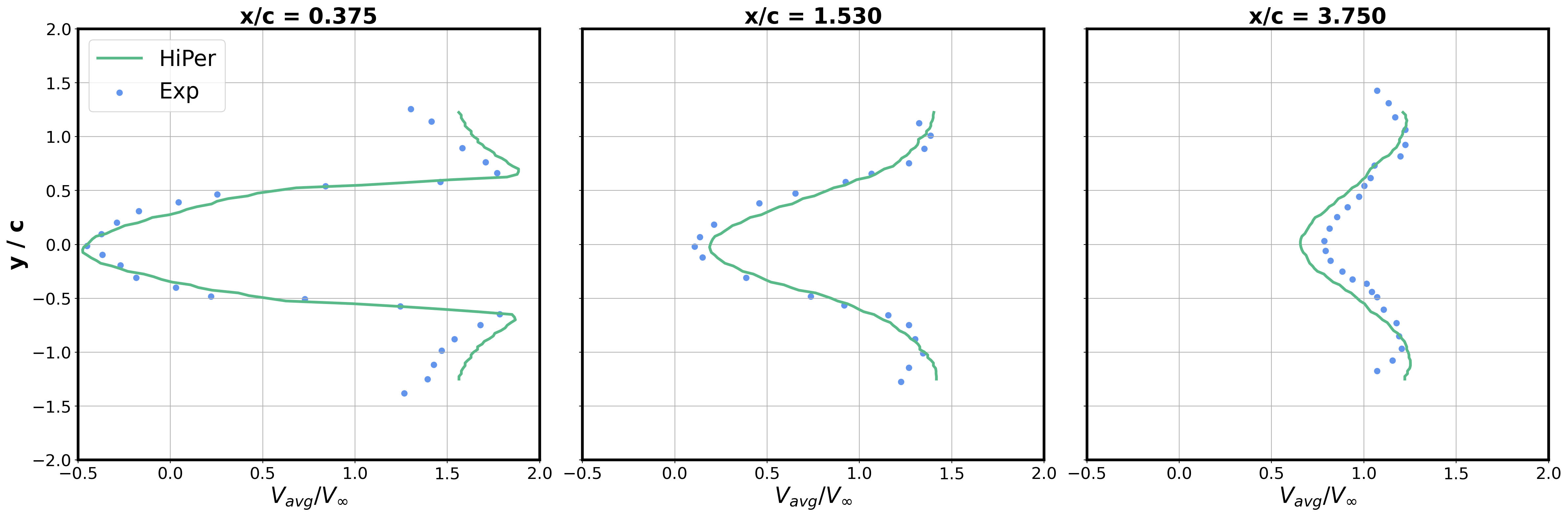
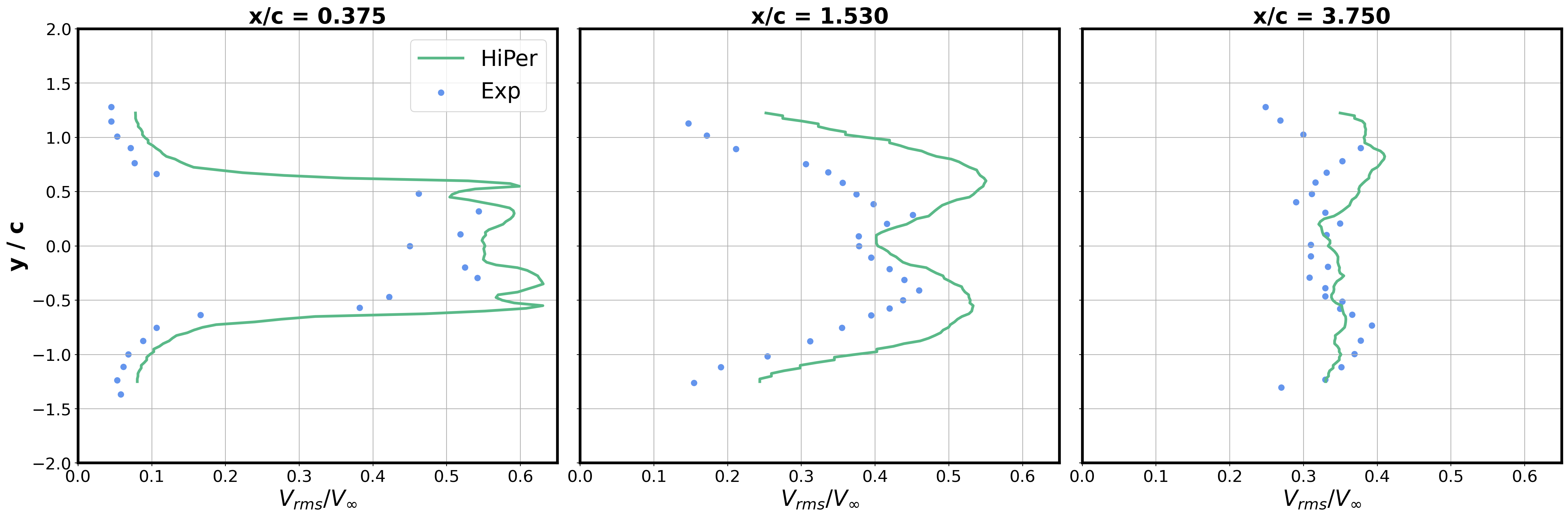
Mean and RMS streamwise velocity profiles are extracted at three stations downstream of the bluff body, at x/h = 0.375, 1.53 and 3.75, and compared against the LDA measurements of Sjunnesson, Nelsson & Max.
The mean velocity profiles agree well with the experimental data at all three stations, correctly capturing the shear-layer peaks and the growth of the wake as it develops downstream. The turbulence (RMS) profiles reproduce the correct magnitude and the characteristic twin-peak shear-layer structure.
References
Computational Performance
9M
Mesh Cells
1×
NVIDIA RTX4090 GPU
40 secs
Per Convective Time Unit
Bring HiPer Onboard
Interested in learning what HiPer CFD can do for your organisation. Contact us for more information or to arrange a demo.