
Introduction
The Taylor-Green vortex is a canonical test case for evaluating the accuracy of CFD solvers in capturing the transition from laminar to turbulent flow and the subsequent turbulent energy cascade. Starting from a simple, analytically defined initial condition, the flow evolves through vortex stretching and the formation of increasingly fine-scale structures, eventually leading to fully developed turbulence and subsequent decay.
This case is particularly valuable for validating implicit Large Eddy Simulation (iLES) capabilities, as the energy dissipation rate provides a sensitive measure of how well the solver captures the turbulent energy cascade without explicit sub-grid scale modelling. The simulation is performed at Re = 1600 on a triply periodic domain.
Kinetic Energy Dissipation Rate
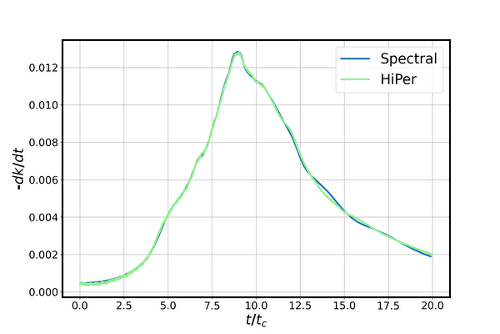
The plot below compares the kinetic energy dissipation rate (−dk/dt) from HiPer against reference spectral DNS data. The dissipation rate is a key indicator of how accurately the solver captures the energy cascade from large to small scales. HiPer shows excellent agreement with the spectral DNS reference, accurately capturing both the peak dissipation rate and the subsequent decay.
Flow Visualisation
The video below shows the evolution of the Q-criterion isosurfaces during the Taylor-Green vortex decay, illustrating the transition from the initial laminar vortex structure through to fully developed turbulence and subsequent decay.
Bring HiPer Onboard
Interested in learning what HiPer CFD can do for your organisation. Contact us for more information or to arrange a demo.