
Introduction
The High-Lift Common Research Model (CRM-HL) is an open-source commercial transport aircraft geometry representative of an industrial high-lift configuration, and was the focus of the 5th AIAA High Lift Prediction Workshop (HLPW-5). The workshop series assesses the ability of current-generation CFD technology to predict the aerodynamics of swept, medium/high-aspect-ratio wings in high-lift configurations, where accurate prediction of maximum lift remains one of the most demanding challenges in applied CFD.
This validation case is Test Case 2.4 of HLPW-5: the full CRM-HL landing configuration, with deployed leading-edge slat, inboard and outboard trailing-edge flaps, slat and flap support brackets, pylon and nacelle with chine, and horizontal and vertical tails. The geometry matches the as-designed ONERA 1/19.5-scale model tested in the ONERA F1 low-speed wind tunnel. Simulations were run at Mach 0.2 and a chord Reynolds number of 5.9 million across an angle of attack sweep from 7.6° to 23.6°, covering the approach condition through maximum lift and into post-stall. Experimental force and moment data from the F1 wind tunnel campaign are available for comparison.
Forces and Moments
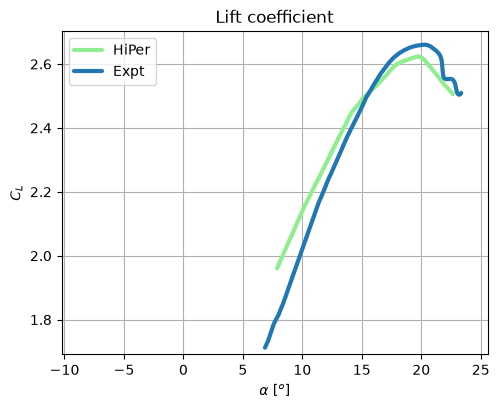
The lift curve compares HiPer against the ONERA F1 experimental measurements. HiPer captures the lift slope through the linear range, the value of maximum lift coefficient and the stalling angle — the region where conventional RANS methods have consistently struggled across the workshop series.
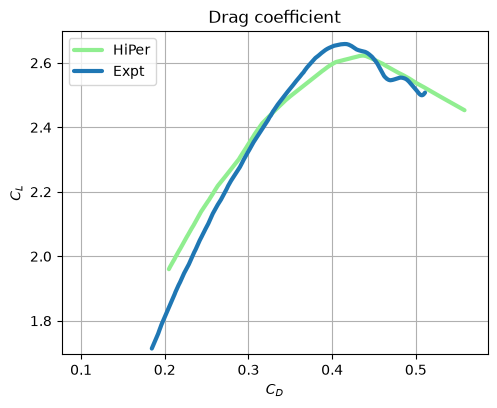
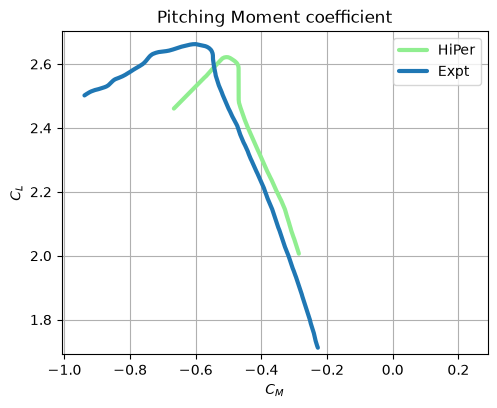
The drag polar and pitching moment show the same level of agreement across the incidence range. The pitching moment is a particularly sensitive measure of the spanwise lift distribution, and the break in the moment curve at stall is well captured.
Flow Visualisation
The video below shows the Q-criterion on the CRM-HL in landing configuration at an angle of attack of 17.7 degrees, revealing the unsteady turbulent flow over the wing upper surface, the wakes shed from the slat brackets and the influence of the nacelle and flap-support fairings
Computational Performance
1B
Mesh Cells
4x
NVIDIA GH200 GPUs
1.42 hours
Per Convective Time Unit
Bring HiPer Onboard
Interested in learning what HiPer CFD can do for your organisation. Contact us for more information or to arrange a demo.